In most of Florida you do need a land clearing permit, and it comes from your city or county rather than the state. In unincorporated Brevard County, Code Section 62-4337 requires a permit before any land clearing activity unless the work is specifically exempt under Section 62-4334. Cities inside the county run their own permits with their own triggers and their own forms.
The permit question is settled by where the parcel sits, not by how big the job feels. A half-acre lot inside Palm Bay city limits and a half-acre lot two miles away in unincorporated Brevard follow different rules, and clearing one the way you would clear the other is how people end up with a stop work order.
What counts as land clearing, and what does not?
Land clearing means removing vegetation, disturbing soil, or taking down trees on a parcel. Routine lawn mowing and ordinary landscape maintenance are not clearing and do not trigger a permit anywhere in Brevard County. The line most property owners get wrong sits between cutting vegetation off at the top and disturbing the ground underneath it.
Surface work generally stays on the safe side. Grading, grubbing, root removal and tree removal generally do not. That distinction matters because the three methods used on an overgrown Brevard lot sit in different places on that line.
- Brush hogging. A rotary cutter pulled behind a tractor mows tall grass, weeds, vines and small saplings down to stubble. Roots stay in the ground and the soil is not disturbed.
- Forestry mulching. A single machine grinds standing vegetation and small trees into mulch that stays on site. No burn piles, no hauling, and no bare graded dirt.
- Full land clearing. Trees come down, stumps and roots come out, and the ground gets graded. This is the version that almost always needs a permit first.
None of that changes the rule for protected trees. A tree that meets your jurisdiction’s size threshold is protected regardless of which machine takes it down. TR Lawn & Tree performs brush hogging and forestry mulching across Brevard County, and the method changes the schedule and the site condition afterward, not the permit requirement.
Land clearing permits in unincorporated Brevard County
Unincorporated Brevard County requires a permit before any land clearing activity unless the work is specifically exempt, under Code Section 62-4337. For smaller residential jobs the county issues a Small Scale Land Clearing Permit through the Natural Resources Management Department in Viera. As of September 2026 the county’s application form cites Code Section 62-4338(7) and states that a $240.00 non-refundable fee is required before the application is processed.
The department is at 2725 Judge Fran Jamieson Way, Building A, Room 219, Viera, FL 32940, and the number listed on the application is (321) 633-2016. Larger projects do not use this form at all. Clearing tied to a building permit, subdivision or site plan gets reviewed inside that application instead.
What the Small Scale permit allows
The application sets hard ceilings on how much of a site can be cleared under it. These are the numbers on the current county form.
- Up to 50% of the understory of the site area, or one acre, whichever is less.
- Up to 10% of the native canopy of the site area.
- Viable specimen trees, meaning a total diameter at breast height of 24 inches or more, cannot be approved for removal and may not be cleared. Non-native invasive plants are excluded from that restriction.
- Mitigation may be required before final inspection for approved removal of viable protected trees, meaning 10 inches DBH or greater.
- Native vegetation in the Surface Water Protection Buffer cannot be removed.
What the Small Scale permit does not do
This is where clearing jobs go sideways after approval. The county form is explicit that the permit is narrow.
- It does not authorize any wetland impacts.
- It does not pertain to protected species laws and requirements.
- The owner or agent remains responsible for obtaining all applicable state and federal permits.
- Only one Small Scale Land Clearing permit is approved per calendar year for any property, regardless of ownership. Selling the parcel does not reset it.
- The owner is responsible for posting the permit on site.
- Once approved, the owner has 30 days from issuance to schedule a final inspection under Section 62-4338(5). Miss it and the permit expires, which can itself become a code violation.
City rules: Cocoa, Palm Bay, Titusville and Rockledge
If your address is inside city limits, the county form does not apply to you and the city’s own ordinance does. Each Brevard city sets its own trigger, its own application package and its own fee schedule. The first thing to establish is which jurisdiction the parcel actually falls in, because a Cocoa or Palm Bay mailing address does not by itself mean the property is inside those city limits.
| Jurisdiction | Permit | What triggers it |
|---|---|---|
| Unincorporated Brevard County | Small Scale Land Clearing Permit, or review inside a site plan or building permit | Any land clearing activity not exempt under Code Section 62-4334 |
| Palm Bay | Tree removal and small residential site land clearing permit (§ 175.014), grubbing permit (§ 175.015), site work permit (§ 175.016) | Trees of 6 inches DBH or greater, palms with 4.5 feet of clear wood or greater, or any land clearing on a residential lot under one acre |
| Cocoa | Tree Removal and Land Clearing Application, through Planning and Zoning | Clearing property, and required at initial submittal with new site plans or subdivision plats |
| Titusville | Clearing and grubbing permit, or Class I site development permit | Land alteration and clearing, with a tree and vegetation survey required before approval |
| Rockledge | Tree removal application, plus a development order where clearing is tied to development | Removing trees or substantially altering a site |
Palm Bay is the one people get backwards
Palm Bay’s current ordinance, § 175.014, adopted 19 September 2024, makes it unlawful to remove a tree of six inches DBH or greater, or a palm with four and a half feet of clear wood or greater, without a permit first. The same permit is also required for any land clearing on a residential lot that is less than one acre. Several tree-service articles still circulating tell Palm Bay homeowners the opposite, that the rule kicks in above an acre. Working off that is how a routine lot cleanup turns into an enforcement file.
The application package is specific: a fee set by resolution, a recorded deed showing the current owner, a signed hold harmless agreement, a letter of authorization if the applicant is not the owner, and a site sketch marking the DBH and species of every tree on the parcel along with which are going and which are staying. The city processes the application within seven days.
Clearing first and applying later is expensive. The ordinance provides for a stop work order, one week to apply, and an application fee set at twice the standard amount. Where a site has already been cleared and there is little evidence left of what was removed, the owner can be held responsible for four restoration trees per quarter acre of disturbed area, or the equivalent mitigation fees.
Do you need a permit to remove a tree on your own property?
Owning the tree does not settle it. In unincorporated Brevard County a tree of 10 inches DBH or greater is treated as protected and its approved removal can carry a mitigation requirement, and a specimen tree of 24 inches DBH or more cannot be approved for removal through the small scale process at all. Non-native invasive species are handled differently from native canopy.
There is one significant state-level exception, and it is narrower than most people assume. Florida Statute § 163.045 bars a local government from requiring a permit, fee, notice or replanting to prune or remove a tree on qualifying residential property when the owner holds written documentation that the tree presents an unacceptable risk. The exemption applies to single-family detached residential property, and it only works if you have the documentation before the work happens.
That documentation has to come from an ISA-certified arborist or a Florida-licensed landscape architect, and it must state that removal is the only practical way to bring the risk down. TR Lawn & Tree does not have an ISA-certified arborist on staff and cannot write that letter for you. If your situation looks like a 163.045 case, hire an independent certified arborist for the assessment first, then bring in a crew. Palm Bay’s ordinance folds this straight into its exceptions list for developed single- and two-family lots that provide the city with the required documentation.
Storm situations are treated separately. Palm Bay allows on-site verbal authorization from the City Manager or a designee where a tree poses an immediate threat, and the chapter’s provisions may be suspended during a declared public emergency after a hurricane. If you are looking at a standing dead tree rather than an emergency, see dead tree removal for how that work gets scoped.
Gopher tortoise burrows can stop a clearing job
A gopher tortoise burrow on or near the work area halts clearing until the permitting is resolved with the Florida Fish and Wildlife Conservation Commission. Clearing, grading or staging equipment within 25 feet of a burrow triggers an FWC permit requirement. Your county land clearing permit does not cover this, and the Brevard application says so directly: approval does not pertain to protected species laws.
The property owner files for the FWC permit, not the contractor. TR Lawn & Tree does not file gopher tortoise permits. Crews stop work and point the customer to FWC rather than clearing around a burrow and hoping.
Walk the parcel before anyone quotes it, including equipment paths and staging areas. Burrows show as a half-moon opening with a mound of loose sand fanned out in front. Finding one is not automatically a dead end, but it has to be handled before a machine rolls, not after.
Wetlands, burn authorizations and the approvals people miss
The local clearing permit is one layer. Three other approvals sit on top of it in Brevard County, and each one operates independently of whether the city or county said yes.
- Wetlands. Clearing that affects wetlands or wetland buffers requires an Environmental Resource Permit from the Florida Department of Environmental Protection or the water management district, which for Brevard County is the St. Johns River Water Management District. Dredge or fill work in wetlands can also require a federal Section 404 permit from the U.S. Army Corps of Engineers.
- Stormwater. Brevard County’s Landscaping and Land Clearing Affidavit states that any area of alteration of one acre or more must obtain a National Pollutant Discharge Elimination System permit from the Florida Department of Environmental Protection. Area of alteration means anything cut, cleared, disturbed, graded or filled, which adds up faster than owners expect once access paths are counted.
- Burning. Open burning of cleared debris requires authorization from the Florida Forest Service, with its own conditions on timing, setbacks and supervision.
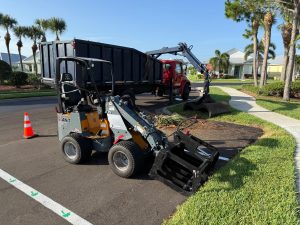
TR Lawn & Tree sidesteps the last one entirely. Cleared material is either hauled off the property or processed into mulch on site. No burn piles, which means no burn authorization to chase and no burn ban to work around. The grapple trucks and mini loader are what make hauling and on-site processing practical on a lot that a pickup and trailer could not clear in a week.
What land clearing permits cost in Brevard County
Permit fees in Brevard County are set locally and change by resolution, so treat any figure you find online as a starting point and confirm it with the office you are applying to. These are the amounts published in the county and city documents as of September 2026.
| Item | Jurisdiction | Published amount |
|---|---|---|
| Small Scale Land Clearing Permit application | Unincorporated Brevard County | $240.00 non-refundable, required before processing |
| Tree removal and small residential site land clearing permit | Palm Bay | Fee set by resolution under § 172.011, not published in the ordinance text |
| Same permit applied for after a violation | Palm Bay | Twice the standard application fee, plus restoration or mitigation |
| Tree removal and land clearing application | Cocoa | Invoiced after the application is reviewed |
| Clearing and grubbing or Class I site development | Titusville | Base fee plus a per-acre amount, set by the city’s fee schedule |
The application fee is rarely what decides a clearing budget. Parcel size, vegetation density, how much can be mulched in place versus hauled out, and equipment access all move the number further. Our Brevard tree removal pricing guide walks through how those same factors work on tree jobs.
How TR Lawn & Tree works around the permit process
TR Lawn & Tree has cleared and maintained property in Brevard County for more than 30 years, and is licensed and insured. Land work runs from forestry mulching and brush mowing through full clearing, grading and hauling, with the mini loader handling heavy loads and land prep.
The permit conversation happens before the quote, not after the machines arrive. That means establishing which jurisdiction the parcel sits in, whether any tree on it crosses a protected size threshold, and whether wetlands or a tortoise burrow are in play. A quote built without those answers is a quote that changes.
TR serves Cocoa, Cocoa Beach, Melbourne, Merritt Island, Mims, Palm Bay, Rockledge and Titusville. You can see the full list on the service areas page, and finished clearing and tree work in the project gallery. For tree work tied to a clearing job, see tree services.
Land clearing permit FAQ
Do you need a permit to clear your own land in Florida?
Usually yes. Florida has no statewide land clearing permit, so the requirement comes from your city or county. In unincorporated Brevard County, Code Section 62-4337 requires a permit before any land clearing activity unless an exemption under Section 62-4334 applies. Owning the property does not exempt you, and neither does clearing only part of it.
What is the penalty for clearing or cutting trees without a permit?
Penalties are set locally and they are not small. In Palm Bay, each failure to comply is an individual violation, the owner or contractor can be issued a stop work order, and the after-the-fact application fee is twice the standard amount. A restoration plan or mitigation fees may follow, and a certificate of occupancy can be withheld until the restoration plan is approved.
What tree can you not cut down in Brevard County?
In unincorporated Brevard County, a viable specimen tree with a total diameter at breast height of 24 inches or more cannot be approved for removal through the Small Scale Land Clearing Permit and may not be cleared under it. Protected trees of 10 inches DBH or greater may be approved, but mitigation can be required before final inspection.
Do you need a permit for forestry mulching?
It depends on what the mulcher takes down, not on the machine. Grinding surface underbrush without disturbing soil or removing protected trees is treated differently from full clearing in most jurisdictions. If any tree on the parcel crosses your city or county size threshold, the tree permit still applies. Check with the jurisdiction before scheduling the work.
How much is a permit to clear land in Brevard County?
Brevard County’s Small Scale Land Clearing Permit application states a $240.00 non-refundable fee, required before the application is processed, as of September 2026. Cities set their own fees separately. Palm Bay’s is established by resolution rather than printed in the ordinance, Cocoa invoices after review, and Titusville charges a base fee plus a per-acre amount.
What should I do if there is a gopher tortoise burrow on my lot?
Stop clearing and contact the Florida Fish and Wildlife Conservation Commission before any work continues. Clearing, grading or staging equipment within 25 feet of a burrow triggers an FWC permit requirement, and the property owner is the one who files for it. A local land clearing permit does not authorize disturbing a burrow or override protected species law.